Build a $2K/Month Productivity Proof Tool This Weekend
A post in r/remotework got 19,207 upvotes with this simple observation: “Remote work is making me realize who on my team was actually working.” The replies were brutal. Thousands of professionals suddenly realized they have zero proof of the quality work they’re doing from home.
This problem—documented in IdeaHunter’s regularly updated database with a 9.2 opportunity score—represents a $3.2 billion market of anxious remote workers who need receipts for their performance reviews.
You’re going to solve it this weekend with one feature. Not four. One.
TL;DR: Your Weekend Blueprint
- The One Feature: Professional-grade weekly performance reports with shareable links
- Tech Stack: Next.js + Airtable + Resend (no auth needed)
- Revenue Target: $2K/month = 40 users at $50/month
- Timeline: Working product by Sunday evening
- First Goal: 5 sign-ups before you sleep Sunday night
Why This Wins (And Why Now)
RescueTime and Clockify track hours. That’s the problem. Hours don’t prove productivity—outputs do. But building automatic tracking across integrated tools would take you six months and require maintaining connections to Google Calendar, Slack, Notion, and LinkedIn APIs.
Forget all that.
Start with manual input and beautiful output. Let users paste their accomplishments into a simple form each week. Your value isn’t the tracking—it’s transforming their scattered wins into a professional performance report they can send to their boss or post on LinkedIn.
Buffer built a $20M business by making social media scheduling simple when enterprise tools were complex. You’re doing the same thing for productivity proof.
The Micro-MVP: One Feature That Prints Money
Here’s what you’re building between Friday night and Sunday afternoon:
A weekly report generator. That’s it.
Users email you (literally, your Gmail) to request access. You send them a unique link: yourapp.com/report/their-email-hash. No passwords. No OAuth. They bookmark it.
Every Sunday, they fill out a simple form:
- What I shipped this week (text area)
- Key metrics/wins (3 bullet points max)
- Time invested (optional, because hours don’t matter)
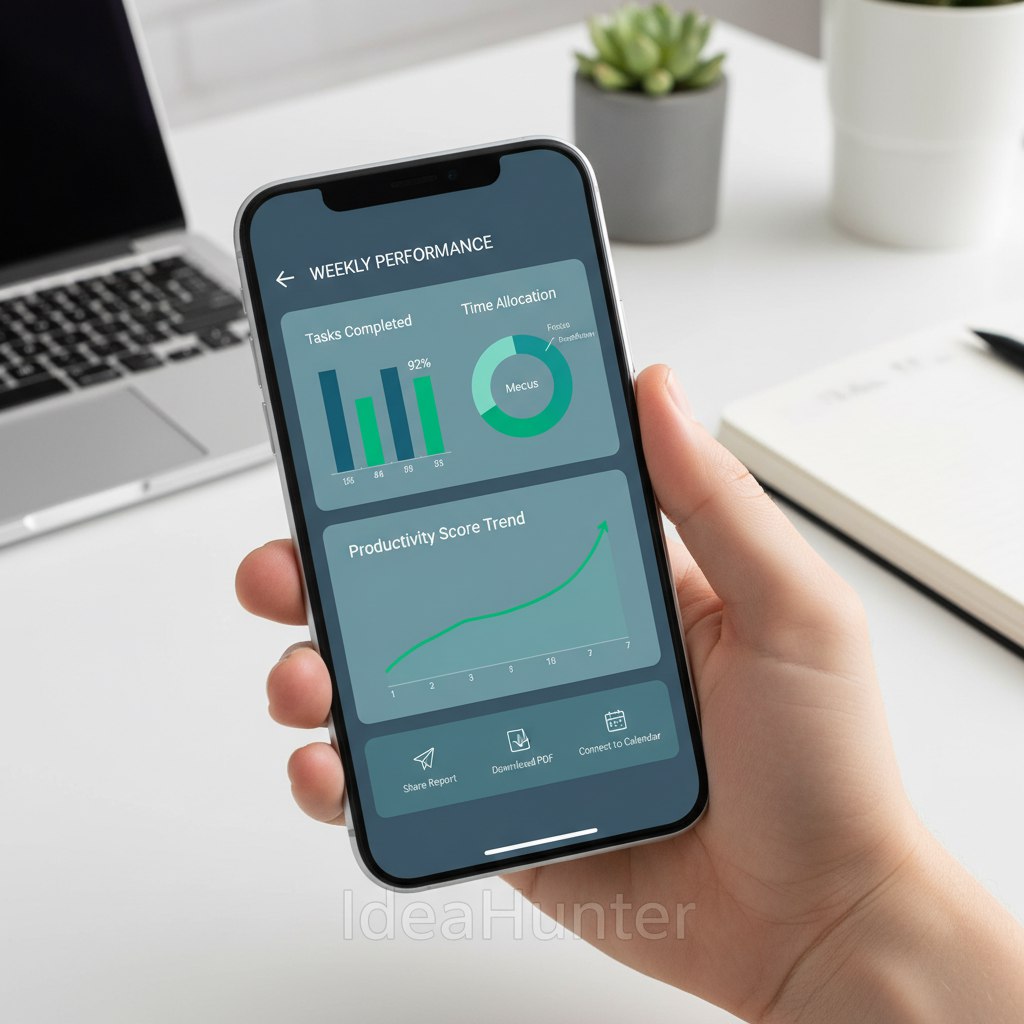
Your script (running on Vercel cron) generates a gorgeous PDF report with their name, the date range, and their accomplishments formatted professionally. It emails them the report with a shareable link.
The report includes a footer: “Generated by [YourAppName] - Proof of productivity for remote professionals.”
That’s the entire product.
The Stack That Ships Tonight
Frontend: Next.js 14 with App Router. Deploy to Vercel. Free tier handles your first 100 users easily.
Database: Airtable. Seriously. You get a beautiful admin interface for free, easy filtering to see who’s active, and you can build the whole schema in 15 minutes. Pay $20/month when you hit scale.
Email: Resend.com. Clean API, 3,000 emails free monthly, takes 10 minutes to integrate. Your weekly reports go out automatically.
Payments: Stripe Checkout links. No subscription logic needed yet—send invoice links manually for your first 20 customers. This sounds insane but saves you 15 hours of integration work.
PDF Generation: react-pdf or Puppeteer. Pick whichever renders your design first.
Build the form first. Make it feel fast and minimal. Two pages total: the input form and a preview of the generated report.
Want to validate ideas faster? IdeaHunter analyzes real problems from communities of millions, scoring opportunities on feasibility and market potential before you write a single line of code.
Getting Your First 5 Users by Sunday
You need humans using this before you sleep Sunday. Here’s the playbook:
Friday night (3 hours): Build the basic form and Airtable schema. Deploy to Vercel with a placeholder landing page explaining the concept.
Saturday morning (4 hours): Build the report generator. Focus on making the PDF look professional—like something a consultant would deliver. Clean typography matters more than features.
Saturday afternoon (2 hours): Test the full flow yourself. Generate 5 sample reports with realistic data. Screenshot the best one.
Saturday evening (2 hours): Hunt for your first users. Post in r/remotework, r/careerguidance, and r/freelance with your problem observation and a link to request early access. DM three friends who work remotely and ask them to try it. Email two former colleagues who complained about performance reviews.
Sunday: Handle support requests, fix bugs, and improve the report template based on feedback. Every person who generates a report is a potential testimonial.
Price it at $49/month from day one. You’re delivering professional-grade output they can use in salary negotiations. That’s worth money. Don’t launch at $9/month and “test pricing later”—just charge what it’s worth.
The 30-Day Path to 50 Users
You won’t get here with organic posts alone. User acquisition cost and professional adoption are your biggest risks according to the opportunity data.
Three channels that compound:
LinkedIn content: Every Monday, share an anonymized example report with insights about proving remote work productivity. Tag it with #remotework and #productivity. You’re selling the outcome, not the tool.
Referral mechanics: Anyone who generates 4+ weekly reports gets a custom link. Every person who signs up through their link gives them a free month. Remote workers talk to other remote workers.
Partnerships: Reach out to 10 remote work coaches, career advisors, or job search consultants. Offer them 30% recurring revenue for anyone they refer. They’re already telling clients to “document their wins”—you’re the tool that does it.
The scary truth: retention challenges will kill you faster than slow growth. If someone signs up but doesn’t generate their first report within 72 hours, they never will. Build an email sequence that sends Wednesday: “Your week is almost over—here’s how to capture your wins in 5 minutes.”
Why Speed Beats Perfect
You’re competing with the idea that people can just “keep a document” of their accomplishments. They won’t. That document doesn’t exist, and it won’t look professional when they need it.
Your unfair advantage is shipping something that works this weekend while your competitors are building automatic Slack integrations for six months.
Could this eventually include automatic time tracking across integrated tools, daily productivity scores, and one-click LinkedIn generators? Absolutely. That’s the $3.2 billion vision. But those features don’t matter if nobody uses version one.
Loom started as a Chrome extension that recorded your screen. That’s it. They added all the fancy features after people cared.
Start with the proof of productivity people can share. Build the automation after you have revenue.
Ship It
By Sunday night, you should have: a working report generator, 5 real users, and at least one person who said “I’d pay for this.” That’s validation. Everything else is iteration.
The opportunity score is 9.2 out of 10. The feasibility score is 8. The problem affects millions of remote workers who have zero proof of their output. You have 48 hours to claim a piece of this market before someone else does.
Ready to find your next weekend build? Explore IdeaHunter.ai’s regularly updated database of validated micro-SaaS opportunities scored on real market demand and technical feasibility. Speed wins. Start now.
Data sourced from a popular Reddit post originally found in r/remotework.
Originally posted in r/remotework with 19,207 upvotes