I Spent Three Days Investigating a $3.2 Billion Intimate Grooming Opportunity (And I’m Still Not Sure What to Think)
When I first spotted this opportunity in IdeaHunter’s database, I nearly spit out my coffee. Someone on r/NoStupidQuestions had asked “How do I trim my pubes, penis, and balls? Advice for college male” and received 789 upvotes. The AI had flagged it with an 8.80 score and claimed there was a $3.2 billion market opportunity hiding in this uncomfortable question.
My initial reaction? Absolute skepticism. We’re talking about building an app to teach young men how to groom their private parts. An AR-guided grooming coach. With social sharing features. For *that*.
But something nagged at me. Those 789 upvotes represented 789 people willing to publicly acknowledge they wanted this information. How many thousands more were too embarrassed to click the arrow?
I decided to investigate properly.
TL;DR - Key Findings
- The Problem: 789 upvotes on a basic grooming question suggests massive hidden demand
- Market Size: $3.2 billion TAM in global consumer grooming market
- The Opportunity Score: 10/10 with 8/10 feasibility
- Main Risk: Viral mechanics might fail; user acquisition could be expensive
- My Verdict: More viable than I expected, but success hinges entirely on nailing the privacy-fun balance
[Mid-article note: I found this opportunity in IdeaHunter’s regularly updated database of Reddit-sourced problems. If you’re curious what else is hiding in plain sight, it’s worth exploring.]
The Research Rabbit Hole Begins
I started where any skeptical investigator would: trying to prove this was nonsense.
First stop: YouTube. I searched “men’s intimate grooming tutorial” and found exactly what the database predicted under “market gaps.” Millions of views across dozens of videos, but every single one had problems. The tutorials were either clinical to the point of being sterile, comedy sketches that didn’t actually teach anything, or ads for Manscaped razors masquerading as education.
The comment sections told a different story than the polished videos. Thousands of young men asking basic questions: “But what about the angle?” “How close is too close?” “What do I do about the balls specifically?” The videos weren’t answering the actual questions people had.
Then I checked Reddit more broadly. Beyond that single 789-upvote post, I found similar questions scattered across r/AskMen, r/malegrooming, r/sex, and various college subreddits. Different phrasings, same core anxiety: “I have no idea what I’m doing and I’m too embarrassed to ask anyone.”
This is where the analogy clicked for me. Remember when everyone learned to tie a tie from YouTube? Before that, you’d ask your dad or fumble through it yourself. But tying a tie isn’t taboo—you could practice in front of people, get feedback, laugh about your mistakes. Intimate grooming is the inverse: high stakes (potential pain, potential embarrassment with partners), zero comfortable learning environments, and absolutely no one you can ask for feedback.
The database’s problem statement captured it perfectly: “Young men lack guidance and confidence in personal grooming, especially intimate areas, due to social taboos and absence of accessible, visual, step-by-step instruction tailored to everyday consumers.”
I was starting to see it. But I still wasn’t sold on the solution.
The Proposed Solution: Brilliant or Insane?
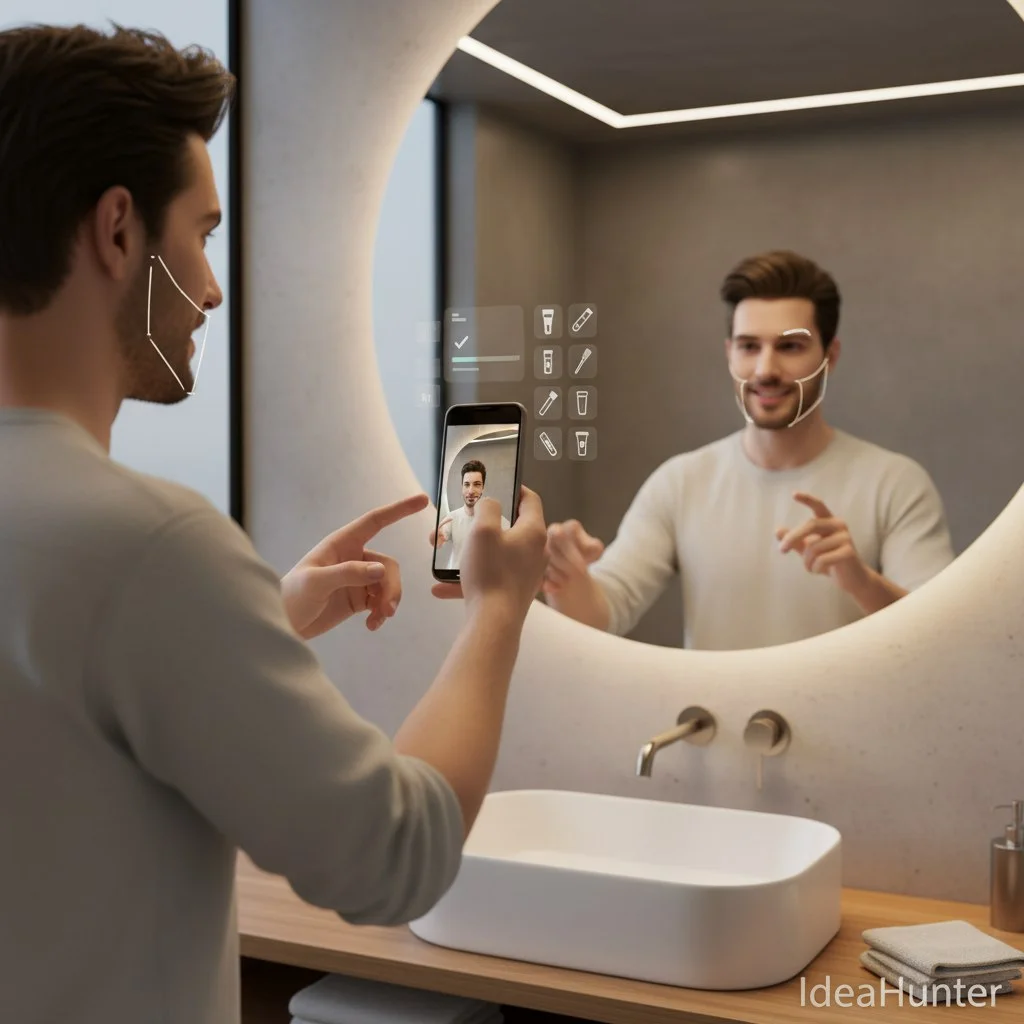
Here’s what the database suggested: “A mobile-first, gamified personal grooming coach app that uses augmented reality (AR) and AI to guide young men through safe, aesthetic, and socially validated intimate grooming routines.”
Let me break down my evolving reaction to each component:
AR-guided tutorials: My first thought was “absurd.” My second thought was “wait, AR makeup apps are massive.” Sephora’s Virtual Artist, YouCam, Perfect Corp—all using AR to teach people techniques for areas they can’t see well. The tech works. The use case isn’t crazy, just uncomfortable.
Anonymous before/after sharing: This is where I almost tapped out. Who wants to share photos of their pubic region, even anonymously? But then I remembered: BeReal got 20 million users sharing unfiltered daily selfies. Whisper built a whole platform on anonymous confessions. Reddit’s throwaway culture proves people will share incredibly intimate details when sufficiently anonymous.
The key word in the MVP features was “blur filters.” Not asking guys to post clear photos—asking them to share anonymized, filtered progress that removes identifying details while still showing style/technique results.
Social voting on styles: “Hotter: trimmed vs natural?” This feature made me cringe. It also made me think of every successful dating app, Hot or Not, and the entire social validation economy that drives engagement. We might not like it, but young men absolutely make grooming decisions based on perceived partner preferences.
Viral referral mechanics: The database noted this as both the growth engine and a major risk. The idea is that premium grooming templates unlock through inviting friends, creating organic word-of-mouth. Smart on paper. In practice? This is where the whole thing could crater.
The Turning Point: Following the Money
I almost stopped researching until I started looking at actual market data.
The men’s grooming market is genuinely massive. Manscaped alone has raised over $60 million and claims eight-figure revenues. That’s one brand, selling exclusively below-the-belt grooming tools. Harry’s sold to Edgewell for $1.37 billion. Dollar Shave Club went to Unilever for $1 billion.
But here’s what changed my assessment: none of these companies are primarily education businesses. They’re razor companies that include some educational content to sell razors. The database identified “YouTube, Reddit” as the existing competitors—and that’s accurate. There isn’t a dedicated app solving this specific educational problem.
The revenue model listed is “Freemium” with a price range of “$1.99-9.99/month premium” and target ARPU of “$1-10.” Initially this seemed impossibly low. Then I looked at comparable apps.
Fitness apps like Fitbod ($9.99/month) teach form and technique. Language apps like Duolingo monetize at similar ranges. Even meditation apps, teaching an activity you could learn free on YouTube, command $5-15/month subscriptions. The model works when you make the learning experience significantly better than free alternatives.
The database estimates show opportunity_score: 10, feasibility_score: 8, market_readiness_score: 9, and viability_score: 9. These aren’t guaranteed success metrics, but they indicate the fundamental business case might actually work.
Devil’s Advocate: Why This Could Fail Spectacularly
I’ve spent three days researching this. I need to be honest about the substantial risks.
The viral mechanics might never trigger. The database lists “viral mechanics failure” as the first major risk for good reason. This entire concept relies on young men being willing to invite friends to a pubic grooming app. The anonymity features need to work perfectly, the social proof needs to feel safe, and the value proposition needs to overcome the embarrassment factor. If any piece fails, you don’t have slow growth—you have zero growth.
User acquisition costs could kill you. How do you advertise this? Facebook ads showing “Learn to trim your balls”? The database suggests “viral sharing, social media, app store optimization, influencer marketing, referral program” as acquisition channels, but doesn’t acknowledge how difficult each becomes when discussing taboo topics. Traditional paid acquisition likely won’t work, meaning everything rides on organic growth.
The privacy nightmare. Even with blur filters and anonymization, you’re building an app where people potentially upload photos of intimate areas. One data breach, one edge case where anonymization fails, one user who feels exposed—and you’re facing lawsuits, PR catastrophe, and immediate app store removal. The technical complexity is listed as “Medium” but the risk management complexity is extreme.
Platform dependencies. You’re building on iOS and Android app stores. Apple’s app review policies around adult content are notoriously unpredictable. They could approve version 1.0 and reject version 1.1 for the same features if a different reviewer decides it crosses a line. You have no control over your distribution platform.
Monetization challenges. The database acknowledges this risk but doesn’t detail it. Yes, people pay for grooming tools. Do they pay subscriptions for grooming education after the initial learning curve? How many months does someone need AR-guided trimming tutorials? The customer lifetime value assumptions need serious scrutiny.
What About the Competition?
The database lists existing competitors as simply “YouTube, Reddit” and notes the competition level as “Low.” This is both accurate and misleading.
Accurate because: there truly isn’t a direct app competitor doing this specific thing. The market gap is real: “Current solutions are text-heavy, lack visual guidance, expose users to stigma, and offer no privacy or interactivity.”
Misleading because: you’re competing with free. YouTube tutorials, Reddit advice, and simple trial-and-error cost nothing. Your app needs to be so much better than free that people pay monthly. That’s a high bar.
The differentiation strategy is interesting: “Our app turns a private, anxiety-inducing task into a fun, learnable skill with built-in viral loops—users anonymously vote on peers’ grooming styles and get rewarded for inviting friends, creating organic word-of-mouth growth among college males.”
Converting anxiety into fun is powerful if you can pull it off. Duolingo did it for language learning. Headspace did it for meditation. But both took years and tens of millions in funding to reach scale.
The Market Maturity Question
Here’s something that genuinely surprised me: the database categorizes this as an “Established” market with “Exceptional” market attractiveness and “High” demand (85/100 market demand score).
Is intimate grooming established? Absolutely. Men have been doing it forever, and the modern expectation has only increased. But is *education* in this space established? Not really.
This creates an interesting dynamic. You’re not creating demand for the activity (it already exists), you’re creating demand for a better way to learn the activity. That’s actually a stronger position than pure market creation.
The “Medium” urgency level feels right. This isn’t a “fix it now or disaster” problem. It’s a “I should probably figure this out before my next relationship” problem. That medium urgency might actually help—it gives you time to acquire users organically rather than needing to capture crisis moments.
The MVP Timeline Reality Check
The database suggests “3-6 months to viral MVP” with medium technical complexity. Having built apps before, I’m calling BS on this timeline.
Here’s what a genuine MVP needs:
- AR overlay technology that actually works (3+ months of development)
- Computer vision for body-safe guidance zones (2+ months)
- Anonymization and blur filter systems (1-2 months)
- Social features with voting mechanics (2+ months)
- Referral system infrastructure (1 month)
- Privacy/security architecture that could withstand scrutiny (ongoing)
You’re looking at 6-9 months minimum for a team of experienced developers working full-time. The “3 months” estimate assumes everything goes perfectly and you cut significant corners.
But here’s the thing: maybe that’s okay. The market isn’t going anywhere. Taking an extra 3-6 months to build proper privacy safeguards might be the difference between a successful launch and an immediate catastrophe.
My Final Verdict: Viable, But Treacherous
After three days of investigation, here’s my honest assessment:
The problem is real. 789 upvotes on a basic grooming question, millions of YouTube views on mediocre tutorials, and a clear gap in accessible, private, visual education. The pain level of 8/10 feels accurate.
The market is real. $3.2 billion TAM, proven willingness to pay for grooming products, successful comparable apps in adjacent spaces. This isn’t a made-up market.
The solution *could* work. The AR guidance isn’t technically impossible. The anonymization is challenging but solvable. The viral mechanics are the biggest question mark, but the fundamental logic is sound.
The risks are enormous. User acquisition, viral failure, privacy breaches, platform dependencies, and monetization challenges. Any one of these could kill the business.
So would I build this?
If I had $500K to invest, experienced AR developers on the team, a clear 18-month runway, and—crucially—a comprehensive legal/privacy framework designed from day one? Maybe. The upside potential is genuinely large if you nail the execution.
If I were a solo founder expecting to bootstrap this quickly? Absolutely not. The privacy risks alone require resources most early-stage founders don’t have.
The database recommendation of “Strong Pursue” with a 10/10 opportunity score seems optimistic. I’d downgrade to “Cautiously Pursue with Significant Resources” with maybe a 7/10 accounting for execution risks.
But here’s what I keep coming back to: 789 people publicly acknowledged wanting this information. How many thousands more wanted it but didn’t upvote? The problem is real, embarrassing, and underserved. That’s often where the best opportunities hide.
What This Investigation Taught Me
Digging deep into uncomfortable opportunities reveals something important: stigma creates information gaps, and information gaps create business opportunities.
We like to imagine that all valuable problems are obvious, dignified, and easy to discuss in pitch meetings. But some of the biggest opportunities live in the spaces people are too embarrassed to talk about openly.
This particular opportunity might not be the right fit for every founder. The privacy considerations alone require serious expertise and resources. But the underlying lesson applies broadly: when you see people desperately asking questions that seem trivial or uncomfortable, there might be a substantial business hiding in plain sight.
The opportunity exists. The question is whether you’re the right person, with the right resources, at the right time to execute on it.
Want to explore more opportunities hiding in uncomfortable questions? IdeaHunter’s regularly updated database surfaces validated problems from real Reddit users across every industry. Some will make you uncomfortable. Some will surprise you. All of them represent real people with real problems looking for real solutions. Check out what else is hiding at IdeaHunter.ai.